Building the Tyne Bridge: A Symbol of Northern Resilience
Introduction: The Industrial Geography of the River Tyne
For two millennia, the River Tyne has served a dual purpose in the geography of North East England. Carving its path through the rugged topography of the region, it has acted as a formidable physical boundary separating the settlements of Newcastle and Gateshead. Simultaneously, it functioned as the primary commercial artery for the British Empire, a waterway that pumped the lifeblood of the nation - coal and ships - out to the rest of the globe. However, by the dawn of the twentieth century, the gorge of the Tyne presented a severe logistical paradox that threatened to strangle the region’s development.
While the river below bustled with the frantic industry of colliers, dreadnoughts, and cargo vessels, the urban conurbation situated on the steep banks above struggled with a suffocating lack of connectivity. The story of the Tyne Bridge, constructed between 1925 and 1928, is fundamentally a narrative of overcoming this topographical divide. It is a chronicle that transcends the mere assembly of 7,000 tons of steel and 750,000 rivets to become a testament to the socio-economic fortitude of a region under extreme duress.
To truly understand the magnitude of this project, one must appreciate the infrastructural deficit that precipitated its conception. Since the Roman era, when the Pons Aelius (c. 122 AD) established the first crossing, the river had been bridged repeatedly, yet never sufficiently for the demands of the modern industrial age. By the 1920s, the primary crossings were relics of the Victorian golden age: the High Level Bridge, a dual-deck marvel opened by Robert Stephenson in 1849, and the Swing Bridge, an engineering feat by Lord Armstrong opened in 1876.
Both structures were failing to cope with the explosive growth of internal combustion traffic. The High Level Bridge was restricted by tolls and the physical limitations of its carriageway, which it was forced to share with trams, creating perpetual bottlenecks. The Swing Bridge, situated at river level, prioritized the river’s maritime commerce. It was frequently swung open to allow the passage of tall-masted ships, thereby severing road communication between Newcastle and Gateshead for extended periods. These interruptions created chaotic tailbacks of motorized vehicles, horses, and pedestrians, paralyzing the flow of daily life.
The geography of the Tyne gorge, with its steep, precipitous banks rising sharply from the water’s edge, dictated that any solution to this traffic crisis must be a high-level crossing. The ambitious vision was to link Pilgrim Street in Newcastle directly to the High Street in Gateshead, allowing through-traffic to bypass the congested, steep descents to the quaysides. While this requirement had been debated in civic chambers as early as 1860, it was the unique pressures of the post-World War I era - specifically the urgent need for unemployment relief - that finally galvanized the Newcastle and Gateshead Corporations into action.
The Economic Crucible: Unemployment and the Politics of Relief
The decade following the Armistice of 1918 was a tumultuous period for the British economy, but for the industrial North East, it was nothing short of catastrophic. The region had been the “arsenal of the world” during the Great War, its shipyards and engineering works running at fever pitch to supply the war effort. The cessation of hostilities brought a precipitous drop in demand for warships and armaments. By the mid-1920s, the “post-war slump” had entrenched itself deeply in the towns along the Tyne, Wear, and Tees.
The coal industry, the bedrock of the local economy, was in crisis, facing stiff competition from emerging oil markets and more efficient foreign mines. Shipbuilding, similarly, suffered from a global surplus of tonnage. The result was mass unemployment on a scale that threatened the social fabric of Tyneside. Statistics from the era paint a grim picture: in 1926, unemployment rates in industrial hubs like Middlesbrough reached as high as 45%, and in specialized shipbuilding towns like Jarrow, the figure would eventually climb to a staggering 80% in the following decade.
It is within this context of desperation that the Tyne Bridge project must be viewed. It was not merely a traffic solution; it was a “relief work” scheme. The Newcastle upon Tyne and Gateshead (Corporations) Bridge Act, passed on August 7, 1924, authorized the construction with a budget of approximately £1.2 million. Crucially, the project received financial backing from the Ministry of Transport, reflecting a central government policy of utilizing large-scale infrastructure projects to absorb surplus labor.
Local politicians and labor exchanges viewed the massive engineering undertaking as a reservoir of employment for skilled workers who had been displaced from the shipyards. The bridge was to be built using shipbuilding techniques - riveting large steel plates - skills that were abundant but idle on the Tyne. The political rhetoric surrounding the bridge was heavily invested in the concept of dignity through labor.
The contract for the bridge’s superstructure was awarded to Dorman Long & Co. Ltd. of Middlesbrough in December 1924. This selection was significant. Dorman Long was not just a contractor; it was a vertically integrated titan of the British steel industry. The firm mined its own coal and iron ore, produced its own steel in the blast furnaces of Teesside, and fabricated the structural members in its own workshops. Choosing Dorman Long ensured that the economic benefits of the project circulated within the distressed North East region. The steel for the Tyne Bridge was “hewn” from the local geology and processed by local hands, reinforcing the bridge’s identity as an indigenous product of Northern industry.
Engineering Architecture: Innovation and the Sydney Connection
The engineering design for the Tyne Bridge was provided by the London consultancy firm Mott, Hay and Anderson. The firm was tasked with designing a bridge that could span the steep gorge without placing any piers in the riverbed - a strict stipulation of the Tyne Improvement Commissioners to ensure the unimpeded passage of shipping traffic to the upper reaches of the river.
The solution was a two-hinged, steel arch bridge with a suspended deck. The arch ribs are of the crescent type, tapering at the ends where they meet the abutment pins and deepening towards the center. This design is structurally rational, placing the material where the bending moments are greatest, and aesthetically dynamic, giving the bridge its characteristic “springing” appearance.
The Hell Gate Lineage and the Sydney “Myth”
A pervasive local myth suggests that the Tyne Bridge was the model for the Sydney Harbour Bridge. While flattering to Geordie pride, the engineering reality is more nuanced. Both bridges share a common ancestor and a common construction team, making them “siblings” rather than parent and child. The morphological inspiration for both the Tyne and Sydney bridges was the Hell Gate Bridge in New York City, designed by Gustav Lindenthal and completed in 1916. The Hell Gate proved the viability of the heavy steel through-arch for long-span rail and road bridges.
The shared DNA between the Tyne and Sydney structures is undeniable. Both involved the firm Mott, Hay and Anderson and Sir Ralph Freeman, the consulting engineer for Dorman Long. However, the contract for the Sydney Harbour Bridge was actually awarded before the Tyne Bridge, in March 1924. Excavations in Sydney began in January 1925, while work on the Tyne commenced later in August 1925.
Crucially, however, the Tyne Bridge was completed first (1928 vs. 1932). This allowed the Tyne Bridge to serve as a vital “test-bed” for the construction methodology. The specific technique of progressive cantilevering using cable backstays was trialed and refined on the Tyne before being executed on the much larger scale required in Sydney. There is even evidence that the temporary cables used to hold back the Tyne Bridge arch were subsequently shipped to Australia to be re-used for the same purpose during the construction of the Sydney Harbour Bridge, creating a tangible physical link between the two landmarks.
Dorothy Buchanan: The Hidden Figures of Engineering
In the male-dominated world of 1920s heavy engineering, the Dorman Long design office was the setting for a quiet revolution. Dorothy Buchanan (1899–1985), a Scottish civil engineer, joined the Dorman Long design team in 1927. Buchanan holds the historic distinction of being the first female member of the Institution of Civil Engineers (ICE).
Buchanan worked on the calculations for both the Tyne Bridge and the Sydney Harbour Bridge. Her role involved the meticulous computation of stresses and loads - essential work in an era before digital calculators, relying instead on slide rules and logarithm tables. She later reflected on her position, stating, “I felt that I represented all the women in the world. It was my hope that I would be followed by many others.” Her contribution, long overshadowed by figures like Freeman, is now recognized as pivotal, with a commemorative plaque recently installed on the bridge to honor her legacy.
The Construction: The “Monkey Men” of the Tyne
The photographic archive of Dorman Long constitutes one of the most significant records of industrial labor in the 20th century. These images do not merely document the erection of steel; they document the extreme conditions endured by the workforce. The workers on the bridge were locally nicknamed “monkey men” or “spidermen,” epithets earned through their daily performance of feats that, to the modern observer, appear almost suicidal.
The lack of safety equipment was characteristic of the era. The men moved between the structural members by lashing ladders together or, frequently, by “shimmying” up the diagonal bracing and columns. Dorman Long photographs capture these men working at heights of up to 200 feet above the river, balancing on narrow steel girders with a casualness that belies the lethal danger. One iconic image shows workers taking a break on the steelwork, seated on the girders suspended over the abyss, smoking pipes and eating sandwiches without safety harnesses, hard hats, or safety nets.
The Tragedy of Nathaniel Collins
The statistical probability of death on such a project was high, and Dorman Long anticipated casualties. Yet, largely due to the skill of the workers, there was only one recorded fatality during the construction of the superstructure: Nathaniel Collins.
Collins was a 33-year-old scaffolder from South Shields, a married man with four children. On Saturday, February 18, 1928 - painfully close to the completion of the arch - tragedy struck. Collins was working near the summit of the arch, approximately 175 feet above the water. Witnesses reported that he reached out to retrieve a plank, lost his footing on the steel, and fell. As he plummeted, he struck the footway of the bridge before splashing into the icy waters of the Tyne.
Dorman Long employed a dedicated waterman, John James Carr, whose sole job was to patrol the river in a small boat to rescue falling workers. Carr rowed furiously to the spot where Collins entered the water and managed to grab the injured man. However, the ebb tide was running strongly. Carr, unable to haul the dead weight of the unconscious Collins into his sculling boat, held onto him with “incredible strength” while the current dragged them both a quarter of a mile downriver. Eventually, a second boatman arrived to assist, but it was too late. Collins died of his injuries in the Newcastle Infirmary. His death serves as a somber reminder of the human cost of industrial grandeur.
Engineering the Arch: The Cantilever Method
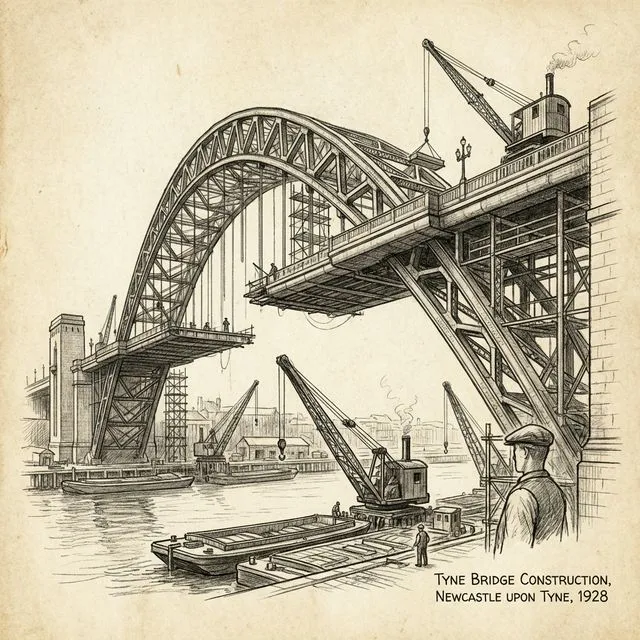
The construction of the Tyne Bridge was an exercise in precision engineering under strict constraints. Since no temporary scaffolding could be placed in the river, the structure had to support itself as it grew outward using the progressive cantilever method.
The process began with the foundations. The geology of the riverbanks required deep excavation to find solid bearing. Massive caissons - watertight retaining structures - were sunk into the banks. This work was carried out under compressed air to prevent water ingress, a hazardous environment for the “sandhogs” digging out the mud. On the Newcastle side, bedrock was reached at 60 feet below datum; on the Gateshead side, at 40 feet.
Once the abutments were secure, the erection of the arch proceeded simultaneously from both banks. To hold the weight of the cantilevering ribs, Dorman Long erected massive steel masts on the approach spans. From these masts, steel cables (backstays) were run down to the upper chords of the arch. As the arch extended further over the river, more cables were added to take the increasing strain. These cables were anchored deep into the ground behind the abutments in specially excavated tunnels.
The actual lifting of the steel was performed by specialized “creeper cranes.” These 20-ton derrick cranes were mounted directly on the top chord of the arch ribs. They would lift the steel members from barges or the deck, place them into position for riveting, and then - in a feat of mechanical ingenuity - winch themselves forward onto the newly completed section to repeat the process.
By February 1928, the two arms of the bridge were reaching toward each other. On February 25, 1928, the final closure operation began. The gap between the two top chords was measured at exactly 9 inches (23 cm). To close this gap, the engineers did not lift the bridge; they lowered it. Using jacking posts located on the approach spans, the tension in the holding cables was slowly released. This allowed the two halves of the arch to pivot on their hinges and descend until the central pins aligned. The precision was absolute. The closure was marked by a cacophony of celebration, with rockets fired from the bridge deck and flags hoisted at the summit.
The Royal Opening and Lasting Legacy
The official opening on October 10, 1928, was orchestrated as a moment of national unity. King George V and Queen Mary arrived in Tyneside to inaugurate the structure, transforming the city into a scene of celebration. Contemporary accounts describe the River Tyne as being in “carnival dress.” Ships moored along the quays were decked out in bunting, sirens shrieked in unison, and a 21-gun Royal Salute boomed across the gorge.
An estimated 500,000 spectators lined the streets and rooftops. The King and Queen traveled in their State Landau, an open horse-drawn carriage, creating a striking visual juxtaposition: the monarch, representing tradition, crossing the steel masterpiece of the modern age. The King’s speech directly addressed the hardships facing the region. He stated, “It is my earnest hope that this notable improvement in the facilities of transport may help to bring back to your city that full tide of prosperity which your courage and patience under recent difficulties so justly deserve.”
A lasting legacy of the opening day arose from a spontaneous gesture by the King. Moved by the sight of thousands of children in the crowd, many of whom were visibly suffering from the effects of poverty and malnutrition, the King and Queen donated £15 to fund a seaside trip for underprivileged children. This donation is cited as the founding moment of the Chronicle Sunshine Fund, a charity that continues to support disabled and disadvantaged children in the North East today.
In the decades since its completion, the Tyne Bridge has transcended its utilitarian function to become the definitive symbol of North East England. To the people of Newcastle and Gateshead, the bridge is affectionately known as “Wor Bridge” (Our Bridge). It represents a specific type of Northern resilience: the ability to produce greatness in the face of adversity. Unexpectedly, the bridge has also become an ecological landmark, providing a nesting site for over 700 pairs of Black-legged Kittiwakes - the furthest inland colony of these seabirds in the world.
In August 2018, the Tyne Bridge was upgraded to Grade II* listed status by Historic England, placing it in the top 5.8% of heritage structures in the country. As it approaches its centenary, undergoing major restoration to return it to its original “Hollybush” green, the bridge remains what it was always intended to be: a steel backbone for a community facing the uncertainties of the future.
References & Further Reading
- The Bridging Of The River Tyne
- Dorman Long Bridge’s Book (1930)
- Proceedings of the Institution of Civil Engineers: Anderson on Tyne Bridge
- Newcastle’s Iconic Tyne Bridge: A Symbol of the City’s Changing Fortunes
- The North East 1920-1938: Industrial Context and Depression