Brunner & Mond: The Foundations of Imperial Chemical Industries
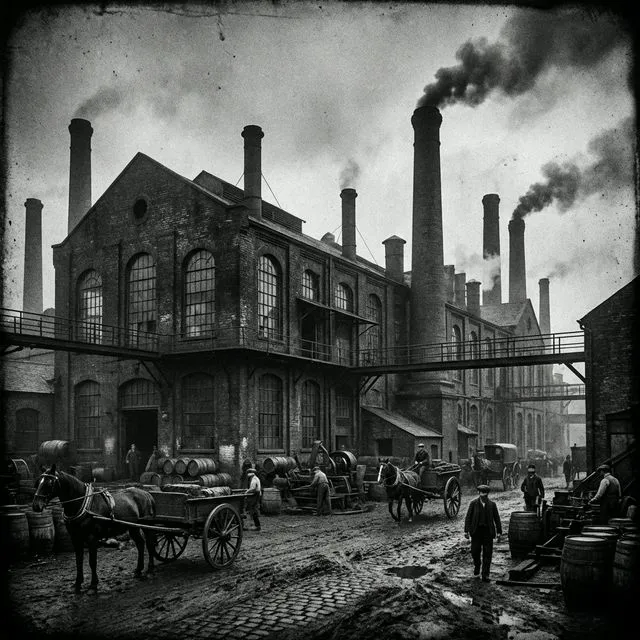
Introduction: The Chemical Architectonics of Northern England
The trajectory of the British chemical industry in the late nineteenth century represents more than a mere shift in production methodologies; it constitutes a fundamental reorganization of industrial capitalism, spatial geography, and labor relations. At the heart of this transformation lies the partnership established in 1873 between John Tomlinson Brunner and Ludwig Mond. Situated in the verdant yet industrially potent Weaver Valley of Cheshire, Brunner, Mond & Co. did not simply introduce a new chemical process to the British Isles; they constructed a corporate edifice that would eventually serve as the foundation for Imperial Chemical Industries (ICI).
To comprehend the magnitude of this enterprise, one must first examine the industrial ecology of Northern England in the early 1870s. The region, particularly the belt stretching from Liverpool to the Pennines, was known as the “workshop of the world.” However, its chemical backbone was calcified. The alkali trade, essential for supplying the textile mills of Lancashire and the glassworks of St Helens, was dominated by the Leblanc process. This method was defined by its inefficiency and its catastrophic environmental footprint. The landscape of Widnes and Runcorn was scarred by acid rain and mountains of “galligu” waste - a testament to a technological paradigm reaching its terminal phase.
Into this entrenched order stepped Brunner, a Liverpool-born commercial manager with a fervent belief in Unitarian liberalism, and Mond, a German-Jewish scientist of singular brilliance and relentless drive. Their partnership was an anomaly: undercapitalized, technologically risky, and geographically isolated at Winnington Hall. Yet, the document they signed in 1873 codified a set of principles that would dismantle the Leblanc hegemony.
Part I: The Document – Analysis of the 1873 Partnership Agreement
The legal instrument that bound Brunner and Mond in 1873 was not merely a contract of commercial cooperation; it was a constitutional document for a new model of industrial enterprise. A forensic reconstruction of its clauses reveals a sophisticated understanding of risk, control, and intellectual property.
1.1 Legal and Financial Precarity
The partnership was forged under the Partnership Act of 1865, which allowed lenders to receive a share of profits without becoming full partners with unlimited liability. This was crucial because Brunner and Mond were capital-poor, with an initial capitalization of less than £20,000 - a sum pitifully small compared to established “chemical aristocrats.”
The agreement utilized the “Sleeping Partner” clause to include Charles Holland, a wealthy engineer who provided £5,000 but possessed no executive authority. This ensured that technical and strategic decisions remained the exclusive preserve of the managing partners, insulating the firm from the conservatism of traditional British capital.
1.2 The Solvay Protocol and Intellectual Property
The most valuable asset in the 1873 Articles was the license from Ernest Solvay. Ludwig Mond had secured an agreement granting the firm exclusive rights to manufacture soda ash using the ammonia-soda process in the British Isles and the United States.
- Territorial Exclusivity: This effectively created a future monopoly, forcing competitors to rely on the inferior Leblanc method.
- Secrecy Clauses: The partners were legally bound to protect the “know-how” of the columns and carbonating towers, recognizing that their competitive edge lay in uncodified operational knowledge.
1.3 The Winnington Hall Clause
The acquisition of the manufacturing site included a unique condition: the partners had to purchase Winnington Hall, a grand mansion, along with the industrial land. This physically embedded the management within the factory perimeter. Living inside the “machine” fostered an obsession with safety and efficiency that became the hallmark of the company culture.
Part II: The Industry – Soda Ash and the Northern Engine
The production of soda ash (sodium carbonate, Na2CO3) was the fundamental chemical reaction of the 19th century. It was the primary alkali used in glass, soap, paper, and textile finishing.
2.1 The Chemistry of Disruption: Leblanc vs. Solvay
The incumbent Leblanc Process was a brute-force, multi-stage batch method:
- 2NaCl + H2SO4 → Na2SO4 + 2HCl
- Na2SO4 + CaCO3 + 2C → Na2CO3 + CaS + 2CO2
This process produced devastating waste products like hydrochloric acid gas and calcium sulfide. In contrast, the Solvay Process brought by Mond was a continuous cycle:
- NaCl + NH3 + CO2 + H2O → NaHCO3 + NH4Cl
- 2NaHCO3 → Na2CO3 + H2O + CO2
The ammonia (NH3) was recovered by reacting ammonium chloride (NH4Cl) with lime, making the process highly efficient and cost-effective. By 1890, soda ash prices fell by 50% due to this efficiency.
2.2 Strategic Geography
Winnington was the nexus of three essential systems:
- The Cheshire Salt Field: Sitting atop the Northwich Halite formation, the firm could pump brine directly from the ground.
- Limestone Link: High-purity limestone (CaCO3) was sourced from Buxton via an expanding rail network.
- River Weaver Navigation: This allowed 250-ton barges to transport coal in and finished soda ash out to the Mersey estuary for global export.
2.3 Symbiosis with Northern Industries
Brunner Mond became the upstream engine for two defining industries:
- Lancashire Cotton: Soda ash was essential for “scouring” cotton to remove natural waxes before dyeing.
- St Helens Glass: The rise of Pilkington Brothers paralleled Brunner Mond. Continuous glass furnaces required the high-purity, iron-free soda ash that only the Solvay process could reliably provide.
| Feature | Leblanc Process | Solvay Process (Brunner Mond) |
|---|---|---|
| Chemistry | Batch; High temperature | Continuous; Low temperature |
| Primary Waste | HCl Gas; Toxic Galligu | Calcium Chloride; Excess Lime |
| Purity | 90-92% Na2CO3 | 98-99% Na2CO3 |
| Labor | Heavy manual labor | Skilled process monitoring |
Part III: Social Impact – The “Winnington Spirit”
Brunner Mond pioneered a form of “Welfare Capitalism” known as the Winnington Spirit. This was a pragmatic synthesis of Mond’s scientific rationalism and Brunner’s political liberalism.
3.1 The Eight-Hour Day Revolution (1889)
In 1889, the firm shifted from the standard 12-hour shift to a three-shift, 8-hour system. Mond meticulously tracked the data and found that the “sickness rate” dropped and yield per man-hour skyrocketed. This proved that shorter hours in a continuous process industry were more profitable than long, exhausting shifts.
3.2 Infrastructure and Paternalism
The company built a civilization from scratch to support its workforce:
- Housing: High-quality terraced housing and unique “corrugated iron bungalows” with central heating were provided.
- Leisure and Health: In 1884, they became the first major British employer to grant a week’s paid annual holiday. They also provided subsidized medical care and converted Winnington Hall into a social club for staff.
While this created a loyal and efficient workforce, it also established “golden handcuffs” - pensions and housing were tied to employment, ensuring extremely low labor turnover during periods of industrial unrest.
Part IV: Evolution – The Road to ICI (1926)
The dominance of Brunner Mond led to the eventual consolidation of the British chemical industry.
4.1 Consolidation and the Nitrogen Pivot
By 1900, the firm had acquired and closed many rivals to control market capacity. They also expanded into electrochemical engineering by acquiring the Castner-Kellner Alkali Company, gaining access to chlorine production.
The First World War acted as a massive catalyst. The need for high explosives led to the development of synthetic ammonia plants using the Haber-Bosch process at Billingham. This shifted the company’s center of gravity toward the North East and established Britain’s capability in synthetic fertilizers.
4.2 The 1926 Merger: The Birth of a Titan
Faced with the global threat of the German conglomerate IG Farben, Sir Alfred Mond (Ludwig’s son) orchestrated a defensive merger. On December 7, 1926, Imperial Chemical Industries (ICI) was formed from four pillars:
- Brunner, Mond & Co.: The financial powerhouse and alkali experts.
- Nobel Industries: The explosives and management leaders.
- United Alkali Company: The former Leblanc rivals.
- British Dyestuffs Corporation: The organic chemistry specialists.
Conclusion
The 1873 partnership was the “Big Bang” of the modern British chemical industry. Through their Articles of Partnership, Brunner and Mond secured the autonomy to deploy a revolutionary technology that rendered the old industrial order obsolete. Their impact on Northern England was total, integrating geology and logistics to feed the global demand for glass and textiles.
When Brunner Mond merged into ICI, the “Winnington Spirit” - a fusion of continental science, commercial daring, and paternalistic responsibility - became the operating system for Britain’s largest manufacturing entity. It remains a definitive chapter in the story of how industrial innovation and social engineering shaped the modern world.
References & Further Reading
- Brunner, Mond and Co - Graces Guide to British Industrial History.
- The Pioneering Years (1863–1914) - Solvay Archives.
- Winnington Hall Records - Science Museum Group Collection.