From Open Market to High Street: The Genesis of Marks & Spencer
From Open Market to High Street: The Genesis of Marks & Spencer
The history of British retail is often told through the lens of grand London department stores, but the true revolution in consumer culture began much further north, amidst the industrial clamor of Leeds. The story of Marks & Spencer is not merely a corporate biography; it is a narrative of architectural evolution, sociological shifts, and an unlikely partnership that bridged the gap between Eastern European migration and Yorkshire pragmatism. To understand the global giant we know today, we must look past the modern food halls and return to the wooden trestle tables of the late Victorian era.
Visualizing the Commercial Revolution
The visual history of Marks & Spencer serves as a photographic archive of the maturation of the British high street. The transformation from the ephemeral to the permanent encapsulates a profound shift in how the working class engaged with commerce.
The Semiotics of the 1909 Briggate Storefront
By 1909, the brand had graduated from the chaotic vibrancy of the market stall to the respectable permanence of the high street. The opening of the store at 76 Briggate in Leeds was a definitive statement of intent. Briggate was the commercial artery of the city, a thoroughfare that signaled legitimacy.
Photographic evidence from this era reveals a storefront designed to project stability while maintaining the populist appeal of its roots. Unlike the temporary stalls of Kirkgate, the 1909 frontage was a fixed entity. The visual language was dominated by its signage. In an era where visual immediacy was paramount, the storefront acted as a billboard. The typography was bold and serifed, often rendered in gold leaf against a dark, contrasting background - typically deep red or green - colors that would eventually become the brand’s signature.
Crucially, the fascia bore the slogan “Originators of the Penny Bazaar.” This served a dual purpose: it reminded the customer of the brand’s value proposition while asserting a claim to authenticity in a market increasingly crowded with imitators. The store also utilized large plate-glass windows, a luxury of the time. These were not minimalist displays; they employed the “heaping” technique, where goods were piled high to convey an overwhelming sense of variety and abundance. The message was clear: here is value, and here is choice.
The “Admission Free” Revolution
Perhaps the most radical visual element of the 1909 store was the prominent display of the words “Admission Free.” To the modern observer, this appears redundant. However, in the context of Edwardian retail, it was a disruptor of social norms.
In traditional dry goods stores, goods were kept behind counters, guarded by clerks. Entering such a space implied a social contract: one entered to buy, not to look. For the working-class shopper, the fear of entering, asking a price, and leaving due to unaffordability created a significant psychological barrier known as “threshold fear.”
The “Admission Free” sign shattered this barrier. It visually codified a new type of public space where mere presence was permitted, and browsing was separated from the obligation to purchase. It effectively invented “shopping” as a leisure activity for the masses, converting the store from a place of transaction to a place of destination.
The Aesthetic of the Penny Bazaar
Five years prior to the Briggate opening, in 1904, M&S had already established a presence in the Cross Arcade. This location acted as a bridge between the market stall and the department store. The arcade location consisted of eight separate units, each dedicated to a specific category: hardware, china, tinware, toys, and haberdashery.
Visual records show a “departmentalized” aesthetic. Rather than the jumble of a peddler’s tray, the units presented an ordered universe of goods. This visual organization was a crucial step in professionalization, mirroring the grand department stores of Paris but scaled down to the penny economy of Leeds.
A surviving photograph of the staff from circa 1906 provides a human context to this operation. It depicts a group of young women, mostly starting work at age 14, dressed in modest dark skirts and white blouses. This uniformity suggests the beginnings of a corporate identity and the standardized service experience that would later define the company. Behind them, shelves are densely packed, highlighting that stock density was the key to profitability in a low-margin business.
The Primal Image: Kirkgate Market (1884)
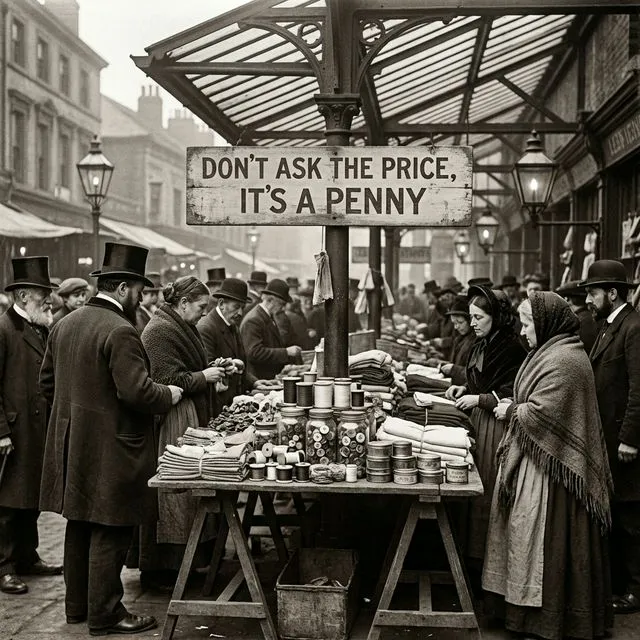
While the 1900s showed a maturing business, the “ur-image” of the company remains the original stall in Kirkgate Market. Images from 1884 (open market) and 1886 (covered market) depict a raw commercial reality.
The structure was essentially a trestle table. The visual dominance belonged to the slogan board: “Don’t Ask the Price, It’s a Penny.” This sign was likely suspended from roof beams, the highest point in the visual field. The table was divided into sections - “fancy goods” on one side, “useful tools” on the other. Small items like nails and spoons were displayed in open trays, inviting customers to touch. This tactile nature was central to the “Penny Bazaar” experience.
The Concept: “Don’t Ask the Price, It’s a Penny”
The genesis of Marks & Spencer was not driven by a revolutionary product, but by a revolutionary mechanism of exchange. Michael Marks’ genius lay in simplifying the adversarial relationship between the retailer and the working-class consumer.
The Psychology of the Penny
In the Victorian marketplace, purchasing was fraught with friction. Prices were rarely fixed, and haggling was the norm. For the affluent, haggling was a social ritual; for the poor, it was a source of anxiety. To ask the price and find it unaffordable was a public admission of poverty.
By fixing the price at a penny, Marks eliminated this negotiation. The interaction became purely transactional and egalitarian. The customer knew the terms of engagement before approaching the stall. This created an immediate bond of trust in an era of “caveat emptor” (buyer beware). Marks offered radical transparency: no hidden costs, no sliding scales based on appearance.
Operationally, this streamlined the process. There was no need to calculate totals or make complex change. A customer put down a penny and took an item, allowing for the high volume of transactions necessary for a business built on razor-thin margins.
Democratizing the Retail Space
The “Admission Free” policy mentioned earlier was more than signage; it was a sociological shift. By declaring the bazaar open to all, Marks acknowledged that the working class had aspirational desires. It allowed a factory worker to spend her lunch hour looking at sheet music or ribbons without the threat of being chased away by a floorwalker. This fostered a deep sense of brand loyalty; customers felt they were guests rather than targets.
The Inventory of the Penny Bazaar
The inventory was a curated mix of the utilitarian and the delightful. The success of the model depended on sourcing goods perceived as “quality” despite the price.
- Haberdashery: Button cards, wool, thread, and needles were non-negotiable necessities for a “make do and mend” culture.
- Hardware: Nails, screws, and scrubbing brushes catered to the pride in domestic respectability.
- Aspirational Items: Stationery and sheet music supported literacy and leisure (the piano was a status symbol in many working-class parlors).
- Toys & Fancy Goods: Tin toys and china ornaments offered “micro-luxuries,” allowing parents to treat their children without financial strain.
The ability to sell these items for a penny was the result of a backend innovation. Initially buying from wholesalers like Isaac Dewhirst, the founders eventually moved to buying directly from manufacturers. This allowed M&S to dictate quality standards and secure bulk pricing, enabling them to sell a scrub brush for a penny that competitors sold for tuppence.
The Partnership: The Refugee and the Yorkshireman
The story of Marks & Spencer is fundamentally a story of symbiosis. It intertwines the history of Eastern European Jewish migration with the commercial traditions of the Yorkshire West Riding.
Michael Marks: The Refugee’s Hustle
Michael Marks was born in 1859 in Slonim, in the Russian Empire (now Belarus). He was part of a generation of Litvak Jews fleeing systemic persecution and pogroms. Arriving in England around 1882, he landed in Leeds penniless, speaking Yiddish but virtually no English.
He began as a “peddler” or swagman, carrying goods on his back to villages surrounding Leeds, such as Wakefield and Castleford. This grueling apprenticeship taught him the geography of the North and the desires of the Northern consumer. He learned English through customer interaction, adopting the local Yorkshire idiom. His start was fueled by a £5 loan from Isaac Jowitt Dewhirst, a Quaker wholesaler - a foundational myth representing the “hand-up” ethos of Victorian philanthropy.
Thomas Spencer: The Yorkshire Administrator
If Marks was the engine, Thomas Spencer was the steering mechanism. Born in Skipton in 1851, Spencer was a local cashier and bookkeeper for Isaac Dewhirst. Unlike the risk-taking Marks, Spencer was a man of ledgers and prudence.
When Marks sought a partner in 1894 to manage his expanding network, Dewhirst recommended Spencer. Having observed Marks’ account grow from a £5 loan to a substantial turnover, Spencer saw the opportunity. He invested £300 for a half-share. While the money was significant, his human capital was more valuable.
The Synergy and Expansion
The partnership, formally registered in September 1894, had an absolute division of labor. Marks handled the merchandise and customers - the “Merchant.” Spencer managed accounts, administration, and logistics - the “Back Office.” Crucially, Spencer used his contacts to bypass wholesalers and open doors to manufacturers.
The financial growth was explosive. From the £300 investment in 1894, the firm was incorporated as Marks & Spencer Ltd in 1903 with a capital of 30,000 £1 shares. In less than a decade, Spencer’s initial investment had grown to a value of £15,000.
This partnership enabled a strategic conquest of the North. Leveraging the railway network, they formalized a “market circuit.” In 1901, they moved the center of gravity to Manchester, building a custom warehouse and head office at Derby Street. This building became the nerve center, coordinating the flow of goods to stalls and shops from Birkenhead to Birmingham.
Legacy: A Cultural Institution
The partnership was tragically short - Spencer died in 1905, and Marks in 1907 - but they built a machine that outlived them. The legacy of M&S extends beyond corporate valuation; it is a touchstone of British identity.
The obsession with quality evolved into the “St Michael” brand, introduced in 1928 by Michael’s son, Simon Marks. The company adopted a scientific approach to retail, establishing textile labs to test durability, industrializing Michael Marks’ original promise that the customer would never be cheated. For the working class, M&S became the place for “Sunday best.”
Leeds remains the spiritual heart of the brand. In 1984, a commemorative clock was unveiled in Kirkgate Market to mark the centenary. In 2013, M&S returned to its roots, opening a Heritage Stall next to the clock. This stall functions as a living museum, selling “archive” items and allowing visitors to experience the scale of the original Penny Bazaar. Furthermore, the M&S Company Archive at the University of Leeds houses over 70,000 items, anchoring the corporate history onto the urban landscape.
From the freezing open-air markets of the 1880s to the granite grandeur of the high street, the company’s early years were defined by a drive to serve the common person with dignity. In the simple slogan “Don’t ask the price, it’s a penny,” Michael Marks and Thomas Spencer found the key to unlocking the aspirations of the working class, laying the foundation for a global giant that never quite forgot its accent.
References & Further Reading
- Marks & Spencer: From Leeds Market to Global Giant
- The M&S Story Timeline (M&S Archive)
- Origins of a Market Leader (The Guardian)
- Marks & Spencer in Leeds (Historic England)
- Tom Spencer (Spartacus Educational)