Cunard Line: The Gateway to the New World
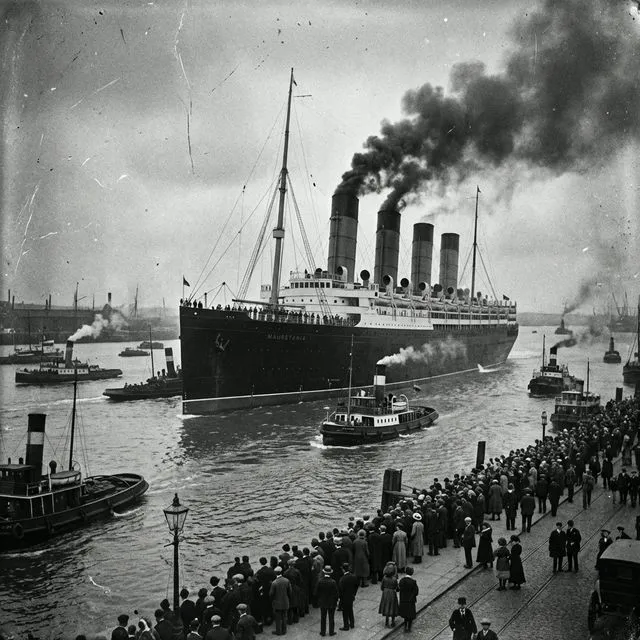
Cunard Line: The Gateway to the New World
When we look back at the nineteenth century, our minds often turn to the heavy industries that defined the era: the extraction of coal and the forging of iron. These were the raw materials that powered the engines shrinking the globe. However, there is another material, far more fragile yet equally enduring, that captures the human essence of this industrial transformation: ink.
Deep within the archives of the University of Liverpool, a solitary, leather-bound book - cataloged as D42/GM10/1 - stands as a quiet witness to a revolution in human mobility. This artifact, known as the Passenger List Volume (July 1840 - December 1844), is far more than a simple register of names. It acts as a foundational document of the modern age. It chronicles the birth of the British and North American Royal Mail Steam Packet Company, which the world would come to know simply as the Cunard Line. Inside its pages lies the record of the specific individuals who inaugurated the first reliable, scheduled bridge connecting the Old World to the New.
The importance of this single volume is difficult to exaggerate. Prior to 1840, the Atlantic Ocean was a formidable barrier, a chaotic wilderness where travel times were held hostage by the whims of the wind. With the arrival of the Britannia class steamers, the ocean was transformed into a highway, ruled not by gales but by timetables, government subsidies, and the pressure of steam. Drawing on archival sources from Northern England, this article reconstructs the lost world hidden within this ledger.
I. The Artifact: A Survivor of the Archives
The very existence of the Passenger List Volume is a stroke of historical luck. During the mid-nineteenth century, the bureaucratic machinery for tracking human movement was still in its infancy. While the British government was deeply concerned with people entering the country (documented in Home Office series HO 2 and HO 3), it lacked a centralized system for recording those who left. There was no “emigration service” in 1840 comparable to the strict documentation protocols later established at Ellis Island. As a result, the commercial ledgers of private shipping firms became the accidental census of the Atlantic.
Sadly, the vast majority of these corporate records have been lost to time - destroyed by company bankruptcies, the ravages of war, or simply the decay of paper in damp port cities. The Cunard Archive, however, was safely deposited at the University of Liverpool in 1973, safeguarding the company’s administrative memory. The 1840-1844 volume is unique because it captures the company’s infancy, a period when Samuel Cunard and his Liverpool partners, the MacIvers, were personally managing the line.
The volume strictly records westbound voyages - from Liverpool to Halifax and Boston. This creates a directional bias, as the Liverpool headquarters managed outbound traffic, while agents in North America would have kept the return ledgers, most of which have vanished.
The Logic of the Ledger
The design of the passenger list reveals the corporate mindset of the 1840s. Unlike the exhaustive manifests of the early 20th century, which demanded details on mental health and ethnicity for immigration authorities, these lists were purely commercial abstracts. Their purpose was to track revenue and assign berths.
The columns were utilitarian:
- Name: Often recorded simply as “Mr. Smith” or “Mrs. Jones,” with full first names appearing only for passengers of high status.
- Profession: A vital indicator of social standing, listing merchants, officers, and diplomats. This helped stewards arrange seating and cabins to ensure social peers were placed together.
- Country: This tracked the nationality of travelers, distinguishing between British subjects and those from the United States or the Continent.
- Age: This was recorded primarily for financial reasons, as children under thirteen were charged half the fare.
- Berth/Cabin: The essential logistical detail for the cramped voyage.
The ledger is also defined by its silence. Children are frequently aggregated into the head of the household’s entry, listed merely as “and child” or “and infant,” rendering the younger generation of travelers statistically invisible. Furthermore, there is a complete absence of steerage passengers. In the early 1840s, the high cost of coal and the inefficiency of engines meant space was too valuable for low-fare travelers. The mass migration of the Irish Famine era would take place on sailing ships; the Cunard steamships of 1840 were the exclusive preserve of the wealthy elite.
II. The Machine: The Reality of the Britannia
To truly understand the experience of the people listed in document D42/GM10/1, one must visualize the vessel that carried them. The RMS Britannia was the technological masterpiece of her time, yet by modern standards, she was tiny, measuring just 207 feet in length.
A Hybrid Beast
The Britannia was a transitional machine. Her primary power came from massive side-lever steam engines built by Robert Napier, which generated 740 horsepower to turn two giant paddle wheels. However, early steam technology was notoriously inefficient. The engines consumed a staggering 38 tons of coal every day. To provide redundancy, the ship was fully rigged with three masts of sails. This allowed the captain to save fuel when the wind was favorable or to keep moving if the mechanical heart of the ship failed. The ship was a complex environment of both soot-belching funnels and canvas sails.
The Logistics of Departure
The entry “Departure from Liverpool” in the archives conceals a complicated logistical dance. The Britannia was docked at the Coburg Dock. Because of the tides, the ship often had to exit the enclosed dock system and anchor in the river before passengers could board. Advertisements from 1840 warned passengers that all heavy luggage had to be loaded days in advance.
On the morning of departure, usually a Saturday, passengers did not simply walk up a gangway. They gathered at the Egremont Slip near Prince’s Dock. From there, a small tender steamer ferried them and their hand luggage out to the liner waiting in the Mersey River. This transfer was often rough, exposing elite travelers to wind and spray before the voyage had even properly begun.
The Sensory Assault of “Luxury”
While Cunard marketed the speed and reliability of the service, life on board was an endurance test. The ticket price was steep - 38 Guineas to Boston - plus a mandatory “Steward’s Fee,” which formalized the tipping culture of the era.
The sensory experience was intense. The pounding of the engines amidships sent constant vibrations through the wooden hull. The air was thick with the smell of sulfurous coal smoke, salt water, and the farmyard odors of live animals. To provide fresh food, the decks were lined with poultry coops, and a cow was kept in a padded stall to supply milk for women, children, and invalids.
The ship’s most significant flaw was the “paddle wheel problem.” In rough seas, as the ship rolled, one wheel would plunge deep into the water while the other spun wildly in the air. This caused violent shuddering and placed immense strain on the machinery, contributing to the wretched seasickness suffered by many.
III. Liverpool: The Ambition of an Empire
The passenger lists also tell the story of a city. In the 1840s, Liverpool was aggressively styling itself as the “Second City of Empire,” a title it fought for against its rival, Glasgow.
The founding of the Cunard Line in Liverpool is a perfect illustration of “Gentlemanly Capitalism.” The empire was driven not just by factories, but by a network of shipping, finance, and services. Cunard’s partners, the MacIver brothers, were central to this ecosystem, managing the credit and government lobbying required to secure the Admiralty contract.
For the passengers, Liverpool offered a spectacle of modern engineering. The massive granite walls of the docks were designed to tame the tidal Mersey. Unlike the port of Bristol, which struggled with the difficult navigation of the River Avon, Liverpool’s floating docks could handle ships at any tide. This logistical superiority allowed Liverpool to monopolize the American trade.
Wealthy travelers required high-end lodging, and the Adelphi Hotel emerged as the primary staging post. It served as a luxurious waiting room, a liminal space where passengers prepared themselves for the ordeal of the Atlantic.
IV. The Human Face of the Manifest
The columns of the ledger come alive when we examine the specific individuals who booked passage.
The Visionary on the Maiden Voyage
The very first entry in the volume marks the service’s inauguration on July 4, 1840 - a date selected to appeal to American sensibilities. The manifest shows that Samuel Cunard himself was on board. His presence was a calculated demonstration of faith in his new machines.
Notably, he traveled with his son, Edward, and his daughter, simply listed as “Miss Cunard.” Bringing his daughter was a strategic marketing move; it signaled to the Victorian public that steam travel was safe and respectable enough for gentlewomen. The voyage ended in triumph, with Cunard honored at a massive banquet for 1,800 people in Boston, sealing the Anglo-American connection.
Charles Dickens and the “Surgical Plaster”
The most renowned entry appears on January 4, 1842: “Charles Dickens… along with his wife and servant.” The famous author was traveling to observe the American republic firsthand.
Dickens’ subsequent book, American Notes, offers the most scathing and vivid description of the Britannia. It was a winter crossing, the most perilous time of year. He famously described his cabin as a “preposterous box,” and lamented that his bunk was as narrow and uncomfortable as a “surgical plaster on an inaccessible shelf.”
He also chronicled the sheer terror of the voyage. During a storm that smashed the paddle boxes, he described the scene in the ladies’ cabin, where his wife and their servant, Anne Brown, were huddled on a sofa, “clinging to each other in momentary expectation of being drowned.” The “servant” listed anonymously in the ledger was a real woman whose fear has been immortalized in literature.
The Ice of 1844
The volume continues to record the line’s struggles against nature. In February 1844, the Britannia became trapped in the frozen harbor of Boston. The local merchants, realizing that their economic link to Liverpool depended on the reliability of the mail service, funded the cutting of a canal through seven miles of ice. This allowed the ship to escape to sea, proving that the regularity of the Cunard schedule had become essential to the transatlantic economy.
Conclusion
The Passenger List Volume (July 1840 - December 1844) is more than an old book in a university archive. It is a time capsule. It captures the fleeting moment when the Atlantic Ocean ceased to be a barrier and became a bridge.
Through this document, we see the convergence of the forces that shaped the nineteenth century: the bureaucratic innovation of the passenger list, the technological daring of the wooden steamship, and the commercial ambition of Liverpool. Most importantly, we see the courage of the passengers. From the visionary Samuel Cunard to the terrified Anne Brown, these individuals stepped onto the tender at Egremont Slip, entrusted their lives to a machine powered by fire, and in doing so, laid the foundations of the modern world.
References & Further Reading
- Passenger List Volume (July 1840 - December 1844), University of Liverpool Cunard Archive
- Coal, Steam and Ships: Engineering, Enterprise and Empire on the Nineteenth-Century Seas
- Charles Dickens: American Notes for General Circulation
- Liverpool: Maritime Mercantile City (UNESCO World Heritage Nomination)
- Information Sheet 17: Cunard Line (Merseyside Maritime Museum)