Alfred Wainwright: The Man Who Mapped the Fells
Alfred Wainwright: The Man Who Mapped the Fells
In the annals of British topographical literature and cartography, few figures occupy a position as singular, or as paradoxically revered, as Alfred Wainwright. To categorize him merely as a guidebook author is to fundamentally underestimate the scope of his contribution to the cultural and physical engagement with the English landscape. Wainwright was an artist, a philosopher of solitude, a reluctant celebrity, and an obsessive chronicler who transformed the rugged, chaotic reality of the Lake District fells into a coherent, artistic, and deeply personal masterpiece.
His seven-volume series, A Pictorial Guide to the Lakeland Fells, produced between 1955 and 1966, stands as a monumental achievement in self-publishing and amateur cartography. It is a work that defies the erosion of time and the obsolescence of technology, remaining as relevant today as it was when the ink was still wet.
Born in the industrial grit of Blackburn, Lancashire, in 1907, Wainwright’s journey to becoming the definitive voice of the Lakeland fells was improbable. He was an accountant by profession, a Borough Treasurer who spent his days balancing municipal ledgers and his evenings and weekends systematically deconstructing the geography of Cumbria. His work emerged from a specific post-war context, a period where the mechanization of leisure and the regimentation of society were accelerating. Against this backdrop, Wainwright’s creation - hand-drawn, handwritten, and intensely human - was a quiet but potent act of rebellion. It was an assertion of the value of individual craftsmanship and the solitary, unmediated experience of nature.
The Architect of the Lakeland Landscape
The Pictorial Guides are unique artifacts in the world of publishing. They contain no typeset text; every letter, every contour line, and every shading hatch was executed by Wainwright’s own hand using pen and ink. This aesthetic choice was not merely stylistic but philosophical. It imbued the guides with an intimacy that suggested a personal correspondence between the author and the reader, a “love letter” to the fells that invited the walker to share in Wainwright’s profound, if sometimes curmudgeonly, affection for the landscape.
The guides are exhaustive in their detail, covering 214 fells with a thoroughness that borders on the pathological, yet they are elevated by an artistic sensibility that captures the mood and spirit of the mountains as effectively as their topography. This report explores the four pillars of his legacy: the unparalleled artistry of his pen-and-ink manuscripts; the obsessive, solitary dedication that fueled his thirteen-year mapping project; the stoic philosophy encapsulated in his famous maxim on weather and clothing; and the enduring impact of his work, from the “bagging” of the Wainwrights to the creation of the Coast to Coast Walk.
The Art: Pen, Ink, and the Handwritten Page
The visual language of the Pictorial Guides is the primary source of their enduring power. In an era where map-making was becoming increasingly standardized and industrialized, Wainwright’s decision to produce his guides entirely by hand was a radical departure. It turned a functional guidebook into an objet d’art, where the distinction between information and illustration dissolved. The aesthetic of the guides is defined by a rigorous control of line, a mastery of texture, and a unique integration of text and image that has rarely been equaled.
The Instruments of Precision
Wainwright’s medium was strictly pen and ink. While modern draftsmen and architects in the mid-20th century were beginning to adopt technical pens like the Rotring Rapidograph, which offered a consistent, unvarying line width, Wainwright adhered to more traditional tools during the creation of the original Pictorial Guides. He utilized dipping pens and fountain pens, instruments that required a deliberate, rhythmic interaction with the inkwell.
This choice of instrument had profound implications for the texture of the drawings. A nib pen allows for variability in line weight based on pressure and angle, giving the line a “nervous” energy and organic quality that a technical pen lacks. It also demanded a slower, more contemplative pace of work. The necessity of frequently dipping the pen enforced a rhythm of draw-pause-draw, allowing Wainwright to constantly assess the balance of the composition. The ink used was standard black waterproof drawing ink, applied to high-quality paper that could withstand the scratching of the nib without bleeding or feathering.
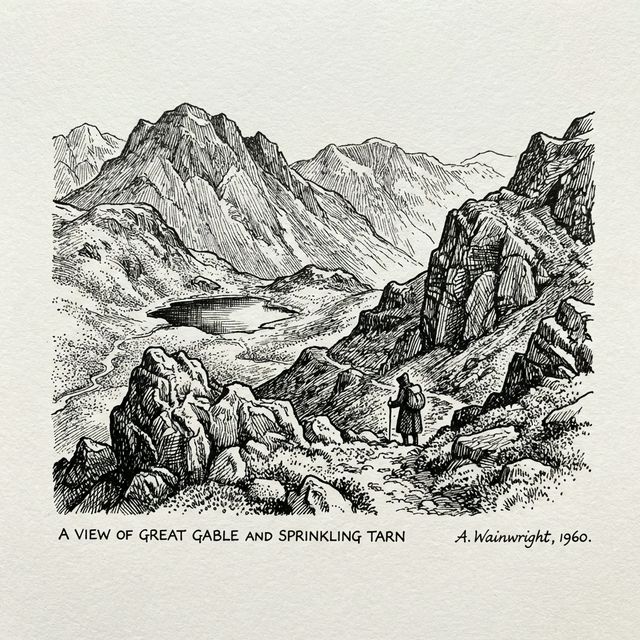
The resulting aesthetic is characterized by dense, intricate cross-hatching. Wainwright rarely used solid blocks of black ink to represent shadow or depth. Instead, he built up tone through layers of intersecting lines. This technique, known as hatching and stippling, allowed him to differentiate with remarkable clarity between the varied textures of the Lakeland terrain:
- Crags and Rock: Depicted with jagged, vertical strokes and heavy cross-hatching to suggest hardness, verticality, and shadow.
- Scree: Rendered as chaotic jumbles of small circles and angular marks, conveying the looseness and instability of the stone.
- Grass and Fellside: Shown with softer, sweeping horizontal lines or sparse stippling, creating a sense of openness and smooth contour.
- Water: Perhaps his most masterful technical achievement. Wainwright depicted tarns and lakes using horizontal lines of varying thickness and spacing, leaving reserves of white paper to suggest reflections and light. The water always appears flat and glassy, anchoring the composition.
The Handwritten Text: “Justification” by Eye and Hand
If the drawings were a feat of artistry, the text was a feat of discipline. Wainwright refused to have his words typeset by a printer, fearing that the mechanical uniformity of type would clash with the organic nature of his drawings. He also wanted total control over the page layout, ensuring that the text wrapped perfectly around the illustrations, a feat that traditional typesetting often struggled to achieve with the precision he demanded.
The most striking feature of his handwriting is the full justification of the text blocks. In typography, justification (aligning text to both the left and right margins) is achieved by varying the spacing between words and letters. For a machine, this is a mathematical calculation. For a human writing in ink, it is a high-wire act of planning.
Wainwright worked on a “page a night” basis. For every single line of text, he would first rule fine pencil guidelines to ensure the writing remained perfectly horizontal. He would then draft the text or count the characters to estimate how much space a sentence would occupy. As he wrote, he would subtly adjust the width of his letters and the spacing between words to ensure that the line ended exactly at the right-hand margin. If a line was going to fall short, he might slightly extend the crossbar of a ’t’ or widen his spacing; if it was going to run long, he would compress the script.
Mistakes were rectified with a razor blade (scraping the ink off the paper) or by pasting a small slip of paper over the error and rewriting. The fact that the final printed books show almost no evidence of this struggle is a testament to his precision. This “justification by hand” created a block of text that possessed a visual density similar to the drawings themselves. The text became a graphical element, a texture of grey that balanced the black of the line work and the white of the page. It transformed the reading experience; the reader is not just scanning information but navigating a visual landscape where word and image are fused.
The Obsession: A Solitary Crusade
The creation of the Pictorial Guides was not a commercial enterprise; it was a compulsion. It was the product of a double life led by a man who was meticulously organized, deeply introverted, and driven by a need to catalog and possess the landscape he loved.
From Blackburn to the Fells
Alfred Wainwright was born into a working-class family in Blackburn. His father was a stonemason with a drinking problem, creating a home environment that was often tense and impoverished. Wainwright was a bright student, excelling in school, but he left at 13 to work as an office boy at Blackburn Town Hall.
His epiphany came in 1930, at the age of 23. He saved up for a walking holiday in the Lake District with his cousin, Eric Beardsall. Arriving in Windermere, they climbed Orrest Head, a modest hill (780 ft) that offers a panoramic view of Windermere and the central fells. Wainwright described this moment as a spiritual awakening: “It was a moment of magic, a revelation so unexpected that I stood transfixed… I saw mountain ranges, one after another… This was truth. God was in his heaven that day and I a humble worshipper.”
From that day, his life had a single trajectory: to escape Blackburn and live among those hills. It took him eleven years of night school and accounting exams to qualify for a position that would allow him to move. In 1941, he accepted a job at the Borough Treasurer’s office in Kendal, taking a pay cut to be closer to the fells.
The Thirteen-Year Routine (1952–1966)
The Pictorial Guides project officially began on November 9, 1952. For the next thirteen years, Wainwright maintained a routine of punishing discipline.
- The Weekend Walker: Wainwright did not drive a car. Every weekend, he would take the bus from Kendal into the Lake District. He would walk extensively, often covering 20 miles and climbing thousands of feet in a day, regardless of the weather. He worked alone, carrying only a map, a compass, a camera (for reference photos), and simple sustenance (often a bar of chocolate).
- The Evening Draftsman: His “real” work began after his day job at the Town Hall. He would retreat to his study in the evenings, working late into the night. He estimated that he completed one page per evening. This implies a staggering level of consistency: over 2,000 pages produced over 13 years, alongside a full-time job and a marriage.
- The Secret: For a long time, his colleagues at the Town Hall were unaware of his project. He was known as the quiet, efficient Treasurer, not the artist. He self-published the first volume, The Eastern Fells, in 1955, handling the distribution himself to local bookshops to avoid the interference of publishers who might want to typeset his work.
Solitude and the “Solitary Wanderers”
Wainwright’s obsession was inextricably linked to his solitude. He was a man who found social interaction draining and difficult. His first marriage to Ruth Holden was unhappy and largely silent; they lived separate lives under the same roof for decades before eventually divorcing. The fells were his escape from a domestic life that felt stifling.
He famously dedicated Book 5: The Northern Fells to “The solitary wanderers on the fells,” identifying a kinship with those who walked alone. He believed that companionship diluted the experience of the mountains. To walk with others was to be distracted by chatter; to walk alone was to be in communion with the landscape. “I am least lonely when alone,” he wrote. This misanthropy spawned many legends. Stories circulated of Wainwright seeing walkers approaching him on a summit and deliberately turning his back, pretending to examine a cairn, or even feigning sleep to avoid conversation. Yet, this was not malice; it was a protective mechanism for a man who experienced the world with an intensity that required silence to process.
The Philosophy: Resilience, Weather, and the “Unsuitable”
Wainwright’s philosophy of the outdoors is grounded in stoicism, resilience, and a deep respect for the indifference of nature. He did not view the mountains as a playground, but as a testing ground for character.
“There’s no such thing as bad weather…”
The quote most frequently associated with Wainwright is: “There’s no such thing as bad weather, only unsuitable clothing.” While variations of this proverb exist in Scandinavian culture, its attribution to Wainwright in the British context is solidified by its appearance in his 1973 book, A Coast to Coast Walk.
Wainwright wrote this in the context of the Northern English climate - notorious for its rain, wind, and fog. The quote serves as a psychological corrective for the walker. By stating there is no “bad” weather, Wainwright removes the moral judgment from nature. Rain is not “bad”; it is simply water. Wind is simply air in motion. To label it “bad” is to impose a human preference on an indifferent universe. The phrase “only unsuitable clothing” places the responsibility squarely on the walker. If you are miserable, it is not the fault of the sky; it is a failure of your own preparation. It is a call to self-reliance.
There is a distinct irony in this quote. In the 1950s and 60s, “suitable clothing” was primitive by modern standards. Wainwright did not have Gore-Tex, merino wool base layers, or Vibram soles. He wore Harris Tweed jackets (which absorbed water but stayed warm), wool trousers, simple cotton shirts, and hobnailed boots. When it rained, he got wet. When it snowed, he got cold. For Wainwright, “suitable clothing” was likely a metaphor for “suitable attitude.” His “waterproofing” was as much mental as it was physical. He accepted the wetness as the price of admission to the fells.
The Fells as “Friends”
Despite his reputation as a curmudgeon, Wainwright’s relationship with the mountains was tender. In the dedication to Book 4: The Southern Fells, he refers to the mountains as “old friends,” describing them as “always there when needed, always reliable, always welcoming.” This anthropomorphism reveals the depth of his emotional reliance on the landscape. People might disappoint him (his marriage, his colleagues), but the fells never would. They were constant. This philosophy of the mountains as steadfast companions drove his conservationist views. He was deeply suspicious of “progress” in the Lake District - opposing forestry plantations, road widening, and anything that tamed the wildness of the landscape. He famously worried that his own books, by popularizing the fells, helped to destroy the solitude he cherished.
Emotional Masterpiece: The Innominate Tarn
To understand the emotional range of Wainwright’s art, one must look closely at a specific page that transcends the utilitarian function of a guidebook. Page 10 of the Haystacks chapter in Book 7: The Western Fells serves as the emotional anchor of the entire series.
The page is dominated by a central pen-and-ink drawing of Innominate Tarn, a small, intricate body of water located near the summit of Haystacks. The tarn is depicted with a complex shoreline of peat hags and rocky inlets. In the background, the looming, darker shapes of Great Gable and Pillar rise like sentinels, their craggy textures contrasting with the stillness of the water.
Surrounding this drawing is text that moves seamlessly from topographical description to profound personal reflection. It is here that Wainwright articulates his final wish, a passage that has become legendary in the hiking community:
“All I ask for, at the end, is a last long resting place by the side of Innominate Tarn, on Haystacks, where the water gently laps the gravelly shore and the heather blooms and Pillar and Gable keep unfailing watch. A quiet place, a lonely place. I shall go to it, for the last time, and be carried: someone who knew me in life will take me and empty me out of a little box and leave me there alone.”
This page elevates the guidebook from a manual to a memoir. It breaks the “fourth wall” of objective description. The reader is not just scanning information but navigating a visual landscape where word and image are fused.
Legacy: The Coast to Coast and the Culture of “Bagging”
Wainwright’s influence extends far beyond the bookshelves. He fundamentally altered the physical behavior of hikers in Britain, creating routes and challenges that have become rites of passage.
The Coast to Coast Walk (1973)
While the Pictorial Guides were his artistic zenith, his most popular legacy in terms of footfall is the Coast to Coast Walk. Published in 1973, this was Wainwright’s attempt to create a long-distance trail that surpassed the Pennine Way, which he found dreary and bog-ridden.
Wainwright designed a route that traversed the breadth of Northern England, cutting across the grain of the landscape to ensure constant variety. He linked existing rights of way to create a continuous 192-mile journey. The walk connects three National Parks, offering a cross-section of English geology and scenery:
- The West: St Bees (Irish Sea) to Ennerdale (Coastal cliffs).
- The Lakes: Ennerdale to Shap (High mountain passes, Kidsty Pike).
- Limestone & Dales: Shap to Kirkby Stephen (Westmorland limestone plateau).
- The Pennines: Kirkby Stephen to Reeth (Crossing the watershed at Nine Standards Rigg).
- The Vale: Reeth to Ingleby Cross (Flat agricultural land).
- The Moors: Ingleby Cross (North York Moors, heather moorland).
- The End: Robin Hood’s Bay (North Sea).
The walk has spawned its own rituals. Walkers traditionally dip a boot in the Irish Sea at St Bees and pick up a pebble. Upon reaching Robin Hood’s Bay on the North Sea, they dip the boot again and throw the pebble into the water. For decades, this was an “unofficial” route, maintained by the goodwill of volunteers and the popularity of Wainwright’s book. In 2022, the UK government officially designated it a National Trail, guaranteeing £5.6 million in funding to upgrade the path, a posthumous validation of Wainwright’s vision.
The “Wainwrights” and Bagging Culture
Wainwright’s selection of 214 fells in the Pictorial Guides created a definitive list known as “The Wainwrights.” Unlike the Munros in Scotland (defined by height: over 3,000 ft), the Wainwrights are defined by the author’s subjective preference. They range from the towering Scafell Pike (3,210 ft) to the diminutive Castle Crag (985 ft). Inclusion was based on whether Wainwright felt the fell had “character” or offered a worthy view.
“Bagging” the Wainwrights (climbing all 214) has become a primary motivation for Lakeland walkers. The Wainwright Society maintains a register of completers, numbering in the thousands. The challenge has evolved into an ultrarunning event. The record for a continuous round of all 214 peaks is held by John Kelly (May 2022), who completed the circuit in 5 days, 12 hours, and 14 minutes. This feat involves over 325 miles of distance and 36,000 meters of ascent (four times the height of Everest), a stark contrast to the slow, contemplative pace Wainwright advocated, yet a testament to the enduring allure of the list he compiled.
Publishing Survival and Evolution
The physical survival of the Pictorial Guides is a story of preservation. For decades, the books were printed using the original plates created from Wainwright’s manuscripts. However, as the Lake District changed (stiles replaced by gates, paths eroded, bus routes altered), the guides began to drift from reality.
Revising the books was controversial. How do you update a work of art? To change the text would be to destroy the visual justification and the author’s voice. The solution adopted by publishers (first Frances Lincoln, now Quarto) was to commission experts like Chris Jesty and later Clive Hutchby to update the guides. They used computer technology to digitally alter the maps and text, painstakingly mimicking Wainwright’s handwriting font to insert new information (e.g., “Parking ticket required”) without breaking the visual continuity of the page. This careful stewardship ensures that the guides remain functional tools rather than just museum pieces.
Conclusion: The Man Who Became the Mountain
Alfred Wainwright’s life was a testament to the power of a single, focused vision. He was an unlikely hero: a quiet accountant who preferred the company of sheep to people, a chain-smoker who climbed mountains in tweed, and an artist who hid his talent for years. Yet, through the sheer force of his obsession, he mapped the English Lake District not just geographically, but emotionally.
His legacy is woven into the fabric of British outdoor culture. It is found in the millions of boot prints on the Coast to Coast path; in the “baggers” ticking off their 214th summit; and in the enduring popularity of his handwritten guides, which continue to outsell modern, glossy competitors. He taught a generation that a map could be a thing of beauty, that a walk could be a pilgrimage, and that the weather is never bad if the spirit is willing (and the clothing suitable).
In the end, Wainwright achieved the fusion with the landscape he so desired. His ashes lie by Innominate Tarn, dissolved into the peat and water of Haystacks. He is no longer the observer sketching the fell; he is part of the fell itself, watched over by Pillar and Gable, forever resting in the quiet, lonely place he loved best.
References & Further Reading
- A Pictorial Guide to the Lakeland Fells
- A Coast to Coast Walk
- Wainwright: The Biography (by Hunter Davies)
- Memoirs of a Fellwanderer
- The Wainwright Society Magazine